
Three regimes, one operating model: build the controls once and evidence them three ways
Strategic Blueprint
One lifecycle, gates, owners and evidence artifacts serves all three regimes.
European Union
Binding & Risk-Tiered
Regulation (EU) 2024/1689 sets product conformity, technical dossiers and bans on unacceptable uses.
Penalties: up to €35M or 7% of global annual turnover.
United Kingdom
Principles & Sectoral
Five cross-economy principles applied by existing authorities: ICO, FCA, CMA and MHRA.
Supervisors assess management controls, not software code.
Australia
Voluntary guidance, binding law
Guidance for AI Adoption sets 6 essential practices, alongside binding Privacy Act reforms and APRA CPS 230.
Automated decision rules take statutory force from Dec 2026.
The operating model on one page
Architecture Overview
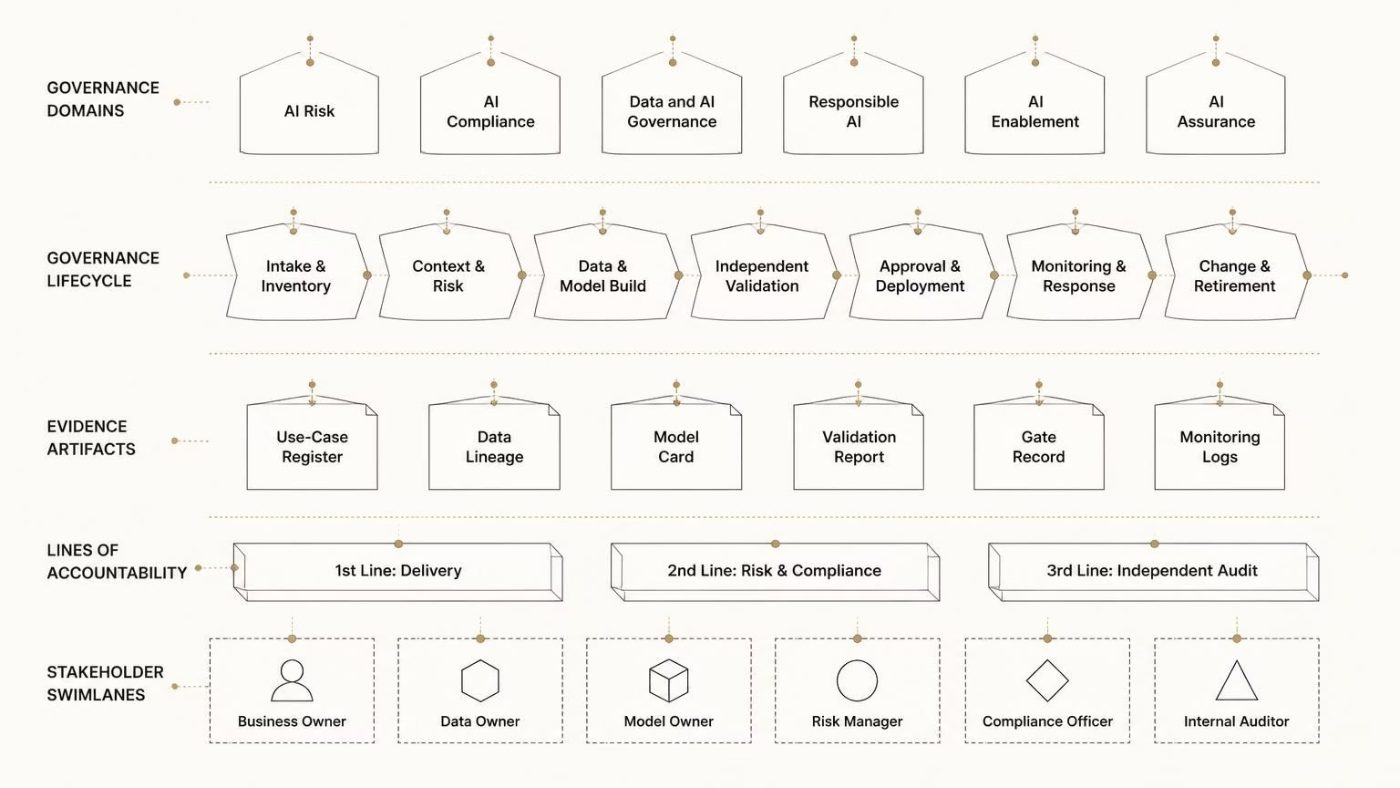
Policies and enablement support the lifecycle; three lines maintain separation of powers.
The regimes differ in force, scope and enforcement
Comparative Legal Analysis
| DIMENSION | EUROPEAN UNION | UNITED KINGDOM | AUSTRALIA |
|---|---|---|---|
| Primary Legal Basis | Regulation (EU) 2024/1689 Single comprehensive statute directly applicable across 27 Member States. | Non-statutory framework 5 cross-sector principles enforced via existing laws (Data Protection, FSMA, Equality). | Hybrid common law Privacy Act 1988, Competition and Consumer Act 2010, workplace and anti-bias laws. |
| Regulatory Stance | Ex-ante conformity assessment, CE marking and post-market deployer monitoring. | Outcome-based, pro-innovation; sector regulators craft domain guidance. | Guidance for AI Adoption (6 practices); voluntary guardrails backed by statutory liability. |
| Parties Covered | Providers, deployers, importers, distributors and GPAI foundation model makers. | Organisations deploying AI within regulated sectors or impacting UK individuals. | Entities operating in Australia, procurement chains, APRA-regulated institutions. |
| Enforcement Body | European AI Office and designated national market surveillance authorities. | ICO, Financial Conduct Authority, Competition & Markets Authority, MHRA. | OAIC, ACCC, ASIC, APRA, Fair Work Ombudsman, AHRC. |
| Maximum Sanctions | €35M or 7% of turnover for prohibited AI; €15M or 3% for high-risk breaches. | Sector-specific caps (e.g. UK GDPR up to £17.5M or 4% of turnover; FSMA fines). | Privacy Act penalties up to AU$50M+ or 3x benefit gained; APRA license conditions. |
Source: EU AI Act (Regulation 2024/1689); DSIT AI Policy Framework; DISR Voluntary AI Safety Standard & Guidance for AI Adoption.
EU: obligations scale with the risk tier of the use case
EU AI ACT · REGULATION (EU) 2024/1689
Prohibited
Social scoring, subliminal manipulation, real-time biometrics in public
High-Risk
Employment screening, credit evaluation, critical infrastructure, law enforcement
Transparency
Chatbots, deepfakes, emotion recognition, synthetic content generation
Minimal
Spam filters, inventory optimization, automated code autocompletion
€35M
Or 7% Of Global Turnover
Maximum fine under Article 99 for deploying prohibited artificial intelligence practices, in force since 2 February 2025.
Hiring & benefit decisions: Explicitly classified under Annex III as high-risk due to potential fundamental rights infringement.
Mandatory literacy: Article 4 applies across all staff operating AI, regardless of use-case risk tier.
Statutory classification floor: systems impacting human livelihoods or safety trigger rigorous conformity assessments and deployer monitoring.
EU dates have moved: plan to the amended timeline
Implementation Cadence
01 Aug 2024
Entry into force; countdown initiates across European Union.
02 Feb 2025
Prohibited AI bans take effect; mandatory Article 4 AI literacy.
02 Aug 2026
Article 50 transparency applies; GPAI obligations binding.
02 Dec 2027
Amended Annex III standalone high-risk system duties commence.
02 Aug 2028
Annex I regulated product integration obligations fully active.
Digital Omnibus Shift
Legislative adjustments revised Annex III timelines from August 2026 to December 2027.
Immediate Mandates
Banned practices and enterprise AI literacy requirements are legally active today.
Verification Notice
Dates reflect tracker consensus; confirm binding publications in the Official Journal before final sign-off.
EU duties land on both providers and deployers
Dual Responsibility Model
Most enterprises operate primarily as deployers of third-party AI, but fine-tuning, branding or altering intended purpose converts a deployer into a statutory provider under Article 25.
Provider Duties (Build & Supply)
Design, Conformity & CE Marking
- Establish and maintain continuous Quality & Risk Management Systems (QMS/RMS)
- Author comprehensive Technical Documentation and ensure data governance rigor
- Conduct conformity assessments and register high-risk systems in the EU database
- Affix CE marking and deliver detailed Instructions for Use to deployers
Model Swimlane: Data & AI Engineering + Legal & Compliance
Deployer Duties (Operate & Oversee)
Operational Oversight & Rights
- Operate strictly in accordance with provider Instructions for Use
- Assign qualified natural persons for meaningful human oversight
- Perform Fundamental Rights Impact Assessments (FRIA) prior to production
- Monitor operations, preserve automated logs (minimum 6 months) and report incidents
Model Swimlane: Business Owner + Risk & Compliance
Universal requirement: Article 4 AI literacy applies equally to provider engineering staff and deployer operational teams.
UK: five principles, applied by the regulator you already answer to
Uk Governance Architecture
Safety & Robustness
Resilience against adversarial drift and failure modes
Transparency
Appropriate explainability of model outputs and logic
Fairness
Prevention of unlawful discrimination and biased outcomes
Accountability
Clear internal governance and named oversight lines
Contestability
Accessible redress routes for affected individuals
No new central AI statute. Sector regulators interpret the five principles through existing powers.
No new central AI statute. Sector regulators interpret the five principles through existing powers.
The UK Department for Science, Innovation and Technology (DSIT) deliberately avoids prescriptive legislation. Financial firms answer to the FCA and PRA; data controllers answer to the Information Commissioner's Office.
Regulatory Leverage
Compliance teams must translate these five principles into standardized technical metrics across validation and monitoring.
Source: DSIT White Paper on AI Regulation; guidance issued to the ICO, FCA, CMA and MHRA.
UK: management-system evidence is the practical route to compliance
Uk Supervisory Practice
Regulators do not audit algorithmic weights directly; they inspect the organisational governance and risk apparatus surrounding deployment.
Domain 01
Governance & Culture
Board awareness, senior executive accountability, and clear risk appetite for autonomous systems.
Domain 02
Inventory & Scope
Centralized register of in-scope algorithms, procurement pipelines and third-party API dependencies.
Domain 03
Lifecycle Controls
Pre-deployment bias testing, independent verification, and continuous post-market surveillance.
Domain 04
Supplier Scrutiny
Due diligence on third-party foundational models, training data provenance, and SLA boundaries.
Dsit Ai Management Essentials
Sector-agnostic self-assessment of organisational processes, not AI products; aimed at SMEs and usable by divisions of larger organisations.
Supervisory Alignment
Pair it with sector regulators' AI guidance, including data protection and financial services supervisors.
Australia: voluntary guidance rests on binding law
Australian Regulatory Baseline
While comprehensive AI statutes remain under parliamentary debate, traditional laws already bind AI use.
6
Essential Practices
Guidance for AI Adoption, published 21 October 2025, evolves the Voluntary AI Safety Standard and its 10 Guardrails.
- Governance frameworks, clear roles and AI registers
- Proportional risk assessments; procurement and supply chain accountability
Au$50M+
Statutory Penalties Active Today
Existing legislation applies to AI without exemption:
- Privacy Act 1988: Data handling, collection limits and upcoming automated notice
- Competition & Consumer Act 2010: Misleading algorithmic claims and dark patterns
- Equal Opportunity & Fair Work: Automated recruitment discrimination liabilities
Guidance is voluntary; existing statutory sanctions are not.
Australia: two binding dates to design for
Australian Enforcement Deadlines
01 Jul 2026
Apra Cps 230 Operational Risk
Service-provider risk
Amended version commencing 1 July 2026; covers service-provider risk, including AI vendors.
10 Dec 2026
Privacy Act
Automated-decision transparency
APP 1 starts 10 December 2026, requiring transparency for automated decisions.
Source: APRA Prudential Standard CPS 230 (Operational Risk Management); OAIC Privacy Act Statutory Review Updates.
Crosswalk: each model domain answers all three regimes
| MODEL DOMAIN | EUROPEAN UNION | UNITED KINGDOM | AUSTRALIA |
|---|---|---|---|
| 1. AI Risk | Art 9 risk management; 4-tier classification. | Safety, Security and Robustness; risk appetite. | Guidance Practice 3; APRA CPS 230 operational risk. |
| 2. AI Compliance | Art 43 conformity assessment; Art 50 transparency. | Sector regulators: FCA, ICO, CMA statutory rules. | Privacy Act APP 1 transparency; Consumer Law dark patterns. |
| 3. Data & AI Gov | Art 10 data governance; bias mitigation; GDPR alignment. | UK GDPR; ICO AI training-data fairness standards. | Australian Privacy Principles; AI-register data lineage. |
| 4. Responsible AI | Art 27 Fundamental Rights Impact Assessment (FRIA). | Fairness; Contestability & Redress protocols. | 8 Artificial Intelligence Ethics Principles; Human oversight. |
| 5. AI Enablement | Art 4 AI literacy; provider instructions for use. | DSIT AI Management Essentials; organisational culture. | Guidance Practice 1: culture, skills, procurement standards. |
| 6. AI Assurance | Art 72 post-market monitoring; automated audit logs. | Accountability & Governance; independent testing. | Independent verification; regulatory-review audit logs. |
One control architecture: AI Risk in Brussels serves London's safety principle and Sydney's prudential guidance.
Six governance domains set the rules, the build standards and the proof
Enterprise Domain Architecture
AI Risk
AI Compliance
Data and AI Governance
Responsible AI
AI Enablement
AI Assurance
Policy & Gatekeeping
AI Risk and AI Compliance set requirements and decision gates across all stages.
Build-Time Standards
Data and AI Governance and Responsible AI act across design and development.
Continuous Proof
AI Enablement supports every stage; AI Assurance tests independently before deployment and during monitoring.
Seven lifecycle stages carry regulatory touchpoints from intake to retirement
Sequential Control Lifecycle
1. Intake
Register all models; capture vendor lineage
2. Context
Tri-jurisdiction risk classification & FRIA
3. Build
Data provenance, model card, explainability
4. Validate
Independent testing: bias, safety & drift
5. Approve
Executive gate sign-off; public notice prep
6. Monitor
Telemetry logging, drift checks & incidents
7. Retire
Secure decommissioning & archive logs
Eu Touchpoints
Art 9 RMS, Art 10 data rules, Art 27 FRIA, Art 43 conformity, Art 72 monitoring.
Uk Touchpoints
Robustness testing, ICO fairness check, DSIT management system, contestability logs.
Australia Touchpoints
Guidance AI Register, Privacy Act APP 1 notice, APRA CPS 230 vendor resilience controls.
End-to-end lineage: an automated system cannot progress from stage to stage without passing explicit gateway criteria.
Stages 1 and 2: register every use and classify it once for all regimes
Lifecycle Stages 1 & 2
Use-case record
Create an AI register for every use. An AI register is an Australian guidance practice.
Impact assessment
Legal, Privacy and Security and Risk and Compliance own the assessment.
Assign one tier
Map the decision to EU prohibited, high-risk, transparency or minimal categories.
Stages 3 and 4: build with lineage, validate independently
Lifecycle Stages 3 & 4
Strict separation between engineering build teams and independent validation preserves integrity and satisfies regulatory audit scrutiny.
Stage 3 · First-Line Build
Data Provenance & Model Cards
Data and AI Engineering teams assemble the core system while maintaining immutable audit trails.
- Data Lineage Record: Training data curation, bias screening, licensing provenance
- Model Card: Intended operating parameters, known performance limitations, latency benchmarks
- Explainability Profile: Feature attribution maps and proxy-variable checks
Stage 4 · Second/Third Line Review
Independent Validation Report
Assurance teams test model boundaries without engineering influence prior to deployment.
- Adversarial Stress Testing: Prompt injection, jailbreak resilience, data leakage
- Disparate Impact Analysis: Demographic parity and equal opportunity metrics
- Direct Regulatory Mapping: Directly satisfies UK Safety & Fairness and EU Annex IV technical audit
Critical control: Validation engineers report through risk management, not software delivery, preventing compromised test standards.
Stages 5 to 7: approve at a gate, watch continuously, retire deliberately
Lifecycle Stages 5, 6 & 7
Governance continues after deployment through post-market feedback and structured decommissioning.
Stage 5 · Approval & Release
Formal Decision Gate
Executive Governance sign-off based on validation reports, residual risk sign-offs, and customer transparency disclosures.
Stage 6 · Monitoring & Incident
Post-Market Oversight
Automated telemetry tracking concept drift, anomaly logs, human escalation queues, and statutory incident notification.
Stage 7 · Decommissioning
Deliberate Retirement
Archiving training data, preserving audit logs (minimum 6 months under EU rules), and transitioning user workflows.
Contestability & Redress
Monitored systems must provide an accessible mechanism for individuals to challenge automated outcomes, fulfilling UK Principle 5.
Statutory Audit Logs
Retaining monitoring logs, validation certificates, and incident tickets satisfies OAIC inquiries and EU AI Office inspections.
Evidence artifacts do triple duty across the regimes
Evidence Architecture
| EVIDENCE ARTIFACT | EU APPLICATION | UK APPLICATION | AUSTRALIA APPLICATION |
|---|---|---|---|
| 1. Use-Case Record | Art 60 In-scope database entry | AI Management Essentials inventory | Guidance Practice 1 AI register |
| 2. Risk & FRIA Assessment | Art 9 RMS & Art 27 FRIA | Data Protection Impact Assessment | Privacy Impact Assessment (PIA) |
| 3. Data Lineage Dossier | Art 10 Data quality documentation | UK GDPR lawful basis & accuracy | APP 3 & 6 personal data collection |
| 4. Standard Model Card | Art 11 & Annex IV technical file | Transparency & explainability file | Voluntary Standard technical record |
| 5. Validation Report | Art 43 Conformity assessment proof | Safety & robustness assurance | Essential Practice 4 verification |
| 6. Gate Decision Notice | Deployer sign-off & oversight log | Governance & accountability record | Senior executive approval memo |
| 7. Transparency Notice | Art 50 Synthetic content disclosure | ICO consumer automated notice | APP 1 automated decision notice |
| 8. Operational Runbook | Art 14 Human oversight protocols | Contestability & redress procedure | APRA CPS 230 operational playbook |
| 9. Incident & Drift Logs | Art 72 Post-market surveillance log | Regulatory audit trail | APRA incident notification proof |
Efficiency dividend: engineering nine standard templates eliminates bespoke regional documentation requirements.
Six swimlanes make ownership explicit at every stage
Operating Governance · Raci
| LIFECYCLE STAGE | BUSINESS OWNER | DATA & AI ENG. | LEGAL / PRIVACY | RISK & COMPLIANCE | ASSURANCE / AUDIT | EXECUTIVE COMMITTEE |
|---|---|---|---|---|---|---|
| 1. Intake | Own | Support | Inform | Consult | Inform | Inform |
| 2. Classification | Consult | Support | Own | Own | Inform | Inform |
| 3. Build | Consult | Own | Consult | Consult | Inform | Inform |
| 4. Validation | Inform | Support | Consult | Review | Own | Inform |
| 5. Approval | Own | Support | Consult | Consult | Inform | Approve (gate) |
| 6. Monitor | Support | Own | Consult | Review | Review | Inform |
| 7. Retire | Own | Support | Support | Inform | Inform | Inform |
Swimlanes: Business Owner; Data and AI Engineering; Legal, Privacy and Security; Risk and Compliance; Independent Assurance and Internal Audit; Executive Governance Committee.
Three lines of accountability keep builders away from the approval pen
First line · Ownership
Business and delivery teams deliver and operate.
Second line · Oversight
Risk, compliance, legal, security and governance set requirements and challenge.
Third line · Assurance
Internal audit gives independent assurance.
Decision gates route high-risk AI to the right level of scrutiny
Gatekeeping Logic
Tier 0 · Prohibited | Stop
Immediate halt: social scoring, dark-pattern manipulation and untargeted biometric scraping. Escalate to Legal; project killed.
TIER 1 · HIGH-RISK | FULL GATE
Full validation and committee approval: hiring tools, credit underwriting, essential service access and biometrics. Validation + FRIA + Committee.
Tier 2 · Limited | Transparency
Transparency controls: customer chatbots, synthetic media generation and internal summarisers. Standard transparency & logs.
TIER 3 · MINIMAL | FAST PATH
Self-attestation: spam filters, inventory forecasting, code autocomplete and game AI. Register entry; instant approval.
Executive Governance Committee Escalation
Escalate risk-appetite breaches, material incidents, unresolved findings (including material validation failure and unresolved bias findings), and novel generative risks to the Executive Governance Committee.
Delivery Velocity
Fast-tracking Tier 3 minimal-risk tools lets 70%+ of enterprise use cases bypass bureaucratic friction while maintaining complete inventory records.
Comply once, evidence three ways: a jurisdiction cascade
Multinational Deployment Strategy
When systems cross geographical boundaries, managing overlapping regional policies introduces compounding technical debt. The cascade strategy anchors on global baseline controls.
Global Enterprise Control Baseline
Calibrated to strictest standard: model cards, bias testing, audit logs & AI literacy
European Union Overlay
Annex IV technical file, CE mark declaration, Art 27 FRIA, EU DB registration
United Kingdom Overlay
Sector regulator mapping (FCA/ICO), contestability routes & explainability logs
Australia Overlay
Privacy Act APP 1 automated notices, APRA CPS 230 vendor contingency clauses
Cross-border rule: A use case touching multiple markets defaults to the highest regulatory tier.
Cross-border rule: A use case touching multiple markets defaults to the highest regulatory tier.
If an algorithm developed in Sydney scores recruitment candidates in London and Frankfurt, it must satisfy EU Annex III conformity and UK Equality Act scrutiny before release.
Operational Payoff
Engineers build to one global API standard; legal teams simply snap on the appropriate regional disclosure packs.
Unified architecture: Local overlays account for less than 15% of total governance effort when the global baseline is properly engineered.
A 12-month roadmap sequences the regulatory deadlines
Execution Roadmap
Q1 · Months 1–3
Core Model — Publish AI register; risk classification questionnaire; interim Executive Committee.
European Union — Audit systems against Prohibited AI list; launch mandatory Article 4 enterprise AI literacy.
United Kingdom — Map use cases to sector regulators (ICO, FCA); benchmark DSIT AI Essentials.
Australia — Assess existing algorithms against 6 Essential Practices and Privacy Act provisions.
Q2 · Months 4–6
Core Model — Standardize 9 evidence templates; train engineering on model cards; telemetry logging.
European Union — Draft FRIA protocols; review third-party GPAI provider documentation & SLAs.
United Kingdom — Formalize explainability and contestability workflows for automated consumer decisions.
Australia — Review critical AI vendors for APRA CPS 230 operational risk requirements.
Q3–Q4 · Months 7–12
Core Model — Independent audit of Tier 1 models; annual model review cadence.
European Union — Prepare for Article 50 transparency (Aug 2026); dry-run Annex III conformity dossiers.
United Kingdom — Integrate AI governance evidence into SM&CR senior manager oversight folders.
Australia — Deploy APP 1 automated decision disclosures before 10 December 2026 deadline.
Milestone sequence: full readiness before APRA CPS 230 (Jul 2026) and Privacy Act (Dec 2026).
Measure whether governance is working
Governance Telemetry
Effective governance delivers both risk reduction and delivery velocity. Executive oversight requires quantifiable operational key performance indicators.
100%
Register Coverage
Target: [100%]
In-scope algorithms catalogued with a verified risk tier.
< 10d
Tier 1 Gate Time
Target: [< 10 Days]
Elapsed time from intake to committee approval.
< 2d
Tier 3 Fast Path
Target: [< 48 Hours]
Attestation velocity for minimal-risk tools.
95%+
Findings Closed
Target: [> 95%]
Validation issues resolved prior to production release.
98%
Ai Literacy
Target: [> 95%]
Mandatory Art 4 completion rate across operators.
Production Reliability
Track production incidents and drift anomalies per deployed system. Zero material regulatory reportable events is the standard.
Continuous Benchmarking
Quantified metrics provide objective proof to internal audit committees and supervisory authorities during periodic reviews.