Two Different Jobs, Often Confused as One
A catalog helps you find data. Governance ensures you can trust it, and use it to make better decisions.
A catalog helps you find data. Governance ensures you can trust it, and use it to make better decisions.
Find It
A catalog surfaces and documents your data assets.
Trust It
Governance ensures quality, ownership, and reliability.
Decide With It
Trusted data drives better business outcomes.
Why This Matters for Insurers
Underwriting, Claims & Actuarial
These teams need trusted data — not just cataloged data. Decisions depend on accuracy and accountability.
Regulatory Reporting
IRDAI, Solvency II, and IFRS 17 compliance fails on trust gaps, not search gaps.
Fraud & Risk Models
Models are only as strong as the governance behind the inputs. Weak governance means unreliable outputs.
A Familiar Pattern Across Insurance Data Programs
Heavy Investment in a Catalog
Thousands of policy, claims, and customer data assets get documented. Significant time, effort, and budget are spent.
Business Teams Don't Use It
Underwriting, claims, and finance teams search elsewhere — or worse, they don't trust the data at all.
Activity Mistaken for Impact
Success gets measured by how much was cataloged, not by the value created. It becomes a theater of activity, not a driver of outcomes.
The fix: govern what matters, not everything you can find.
The Gap Between Documented and Used
Documented
Cataloged but rarely adopted
Owned
Clear responsibilities assigned
Trusted
Reliable, validated data sources
Used
Actively driving decisions
Most insurance data programs achieve documentation but stall before reaching genuine ownership, trust, and adoption. The catalog fills up — but the value never materializes.
Why This Happens
Every reason traces back to one gap: nobody owns the outcome.
Catalog Everything
We catalog everything instead of what matters most to the business.
No Business Involvement
Business teams aren't involved in deciding what to govern.
Documentation Over Decisions
The focus stays on documentation, not on enabling decisions.
No Ownership or Accountability
There is no clear ownership or accountability for data quality.
No Link to Outcomes
No connection exists back to business outcomes or measurable impact.
Data Catalog vs. Data Governance
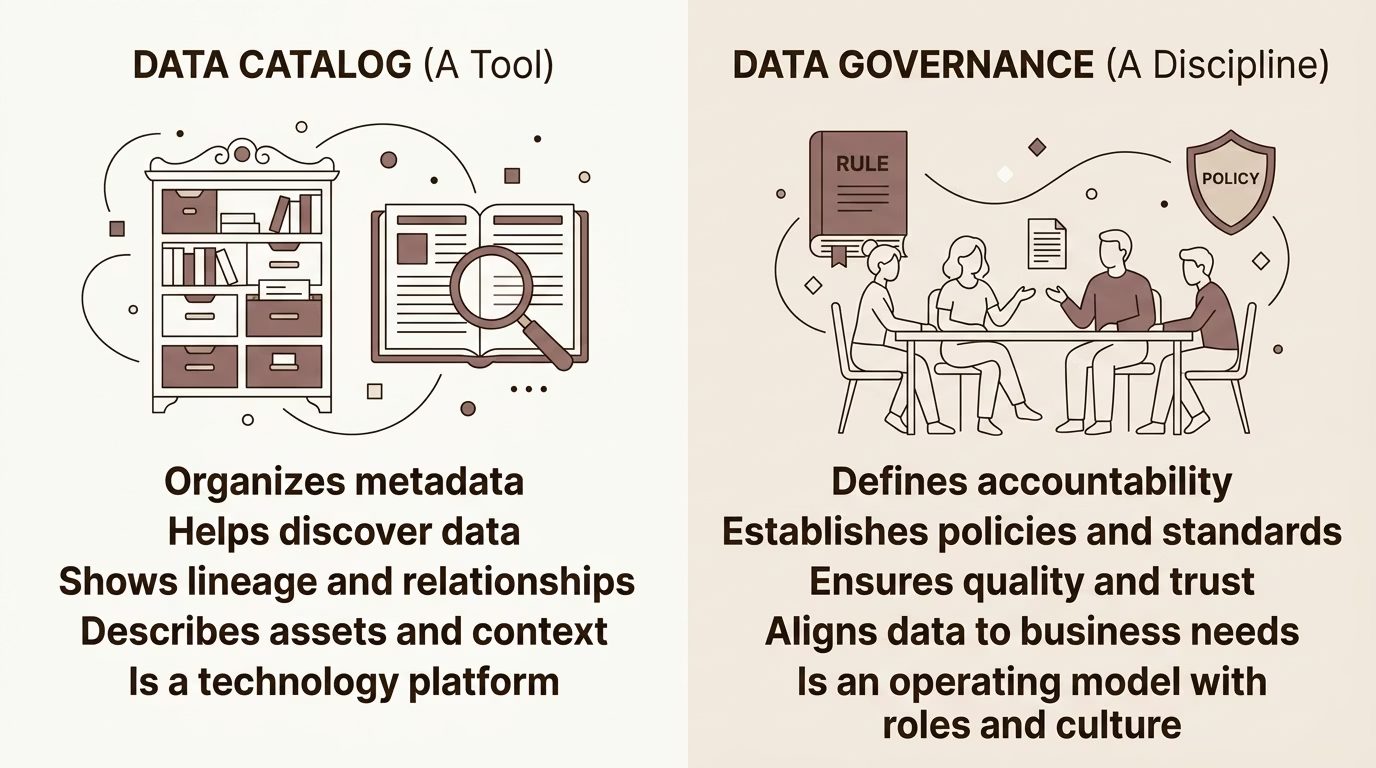
A catalog is powerful. Governance makes it matter. Without governance, a catalog is just a repository that rarely drives value.
Governance Brings What the Catalog Cannot
Purpose
Focus governance on data that drives real decisions.
Accountability
Clear ownership for every critical data domain.
Quality
Standards and rules that ensure data is fit for use.
Trust
Confidence that data is reliable across all teams.
The Shared Goal & What Really Creates Value
The Goal We All Share
- Right data, right quality, right access
- In the right context, at the right time
- For the right decision
Serving Policy & Underwriting → Claims → Actuarial & Risk → Compliance
From Problem to Outcome
The Problem: Documented data that didn't matter. No ownership, no usage, no impact.
The Result: Low adoption, poor data quality, no improvement in decisions.
The Outcome We Need: Focus on what matters. Establish accountability. Drive trust, deliver impact, create business value.