What Is a Governance Domain?
Definition
A Governance Domain is a logical boundary that groups data assets, policies, and stewardship responsibilities under a specific business unit or subject area. It is the organisational construct through which accountability and ownership are formally assigned within Microsoft Purview.
Purpose
The primary purpose is to enforce accountability, ownership, and policy at an organisational level — ensuring that every data asset has a named owner and that applicable compliance rules are actively managed and auditable.
Think of it as...
A Governance Domain is the "who is in charge" layer of your data estate. It maps directly to your organisation's reporting lines and regulatory responsibilities. It answers questions like: who approves access to this data? Who is accountable if a compliance audit is raised? Who writes and enforces the retention policy?
Illustrative Example
A Finance Governance Domain owns all financial data assets across the enterprise. It assigns named data stewards from the Finance department, defines data access policies aligned to SOX and internal audit requirements, and tracks governance health scores to ensure ongoing compliance. The domain is the formal home for financial data accountability — not just a folder, but a governed jurisdiction.
Key question it answers: "Who is responsible for this data?"
What Is a Data Domain?
Definition
A Data Domain is a conceptual grouping of related data assets based on subject matter or business function within the Purview Unified Catalog. Unlike a Governance Domain, which is anchored to organisational structure, a Data Domain is anchored to the nature of the data itself.
Purpose
The primary purpose is to organise and classify data assets by business context, making them easier to discover, understand, and trace through lineage relationships. Data Domains are the semantic layer of your catalog — they give business users a meaningful way to navigate the data estate without needing to know technical system names or schema details.
Illustrative Example
A Customer Data Domain groups all customer-related datasets, attributes, reports, and glossary terms — regardless of which system they originate from (CRM, ERP, data warehouse, or data lake). An analyst searching for customer churn data, a steward defining the term "Active Customer", and a data engineer mapping lineage from source to BI report all benefit from this shared, subject-aligned grouping.
Think of it as...
A Data Domain is the "what kind of data is this" layer of your catalog. It cuts across systems and technical boundaries to create a unified, business-friendly view of related information. It supports discoverability, glossary alignment, and lineage mapping — all centred on a shared subject area.
Common Data Domains in Enterprise
- Customer & Party
- Product & Catalogue
- Finance & Accounting
- Employee & HR
- Supply Chain & Logistics
- Risk & Compliance
Key question it answers: "What kind of data is this?"
Side-by-Side Comparison
At first glance, Governance Domains and Data Domains can appear to serve similar purposes. The table below clarifies how they differ across five critical dimensions — helping you select the right construct for each governance scenario.
| Attribute | Governance Domain | Data Domain |
|---|---|---|
| Focus | Ownership & Policy Enforcement | Classification & Organisation of Assets |
| Driven by | Business Unit / Organisational Structure | Subject Matter / Business Context |
| Primary Users | Data Stewards, CDO, Compliance Officers | Data Architects, Analysts, Business Users |
| Scope | Policies, Roles, Responsibilities, Health Metrics | Assets, Glossary Terms, Lineage, Data Products |
| Hierarchy | Top-down (aligned to org chart) | Bottom-up (aligned to data subject areas) |
| Key Question | Who is accountable for this data? | What kind of data is this? |
These two constructs are complementary, not competing. A mature Purview implementation uses both simultaneously — Governance Domains establish WHO owns data, while Data Domains clarify WHAT that data represents. Together they form a complete governance fabric.
When to Use a Governance Domain
Choose a Governance Domain when the primary driver is accountability, policy enforcement, or compliance. These scenarios are typically initiated by the Chief Data Officer, legal, or compliance teams, and require formal role assignments within Purview.
Assigning Business Unit Ownership
When a specific business unit — Finance, HR, Legal, Operations — must be formally accountable for a set of data assets, a Governance Domain provides the structural container. Named data owners and stewards are assigned directly within the domain, creating an auditable ownership record.
Enforcing Compliance Policies
When regulatory frameworks such as GDPR, HIPAA, SOX, or CCPA require documented data handling policies, Governance Domains are the vehicle for applying and tracking those policies within Purview. Retention schedules, access restrictions, and sensitivity classifications are all managed here.
Defining Stewardship Roles Across Teams
When multiple teams contribute to or consume data under a shared subject, a Governance Domain allows you to formally define and communicate who holds stewardship responsibilities — preventing ownership ambiguity that leads to data quality degradation.
Managing Access Control at Domain Level
When access decisions need to be made at a business-unit or subject level — rather than asset by asset — Governance Domains provide the scope boundary within which role-based access control (RBAC) policies are applied consistently across all contained assets.
Guiding question: If you're asking "Who is responsible for this data?" — you need a Governance Domain.
When to Use a Data Domain
Choose a Data Domain when the primary goal is organisation, discoverability, or semantic clarity across the catalog. These scenarios are typically led by data architects, catalog stewards, or business analysts who need users to find and understand data quickly and consistently.
Organising Assets by Business Subject
When data assets from multiple systems (data lake, data warehouse, operational databases) relate to the same business concept — such as "Product" or "Supplier" — a Data Domain groups them under a common subject umbrella, making the catalog navigable by business context rather than technical source.
Building a Subject-Aligned Business Glossary
When creating or expanding your business glossary, Data Domains provide the natural scoping mechanism. Terms like "Net Revenue", "Active Customer", or "Headcount" are anchored to their respective domains, ensuring that definitions are contextually appropriate and ownership of glossary terms is clear.
Improving Data Discoverability
When business users struggle to find relevant data in a large catalog, Data Domains act as browse categories — reducing time-to-data and improving self-service adoption. A well-structured set of 8–15 domains can dramatically reduce catalog search friction across the enterprise.
Mapping Data Lineage Within a Subject Area
When tracing how data flows from source to consumption within a subject area — for example, how raw transaction records become a Finance dashboard — Data Domains provide the semantic boundary within which lineage relationships are contextualised and easier to interpret.
Guiding question: If you're asking "What kind of data is this?" — you need a Data Domain.
Components of Each Domain Type
Understanding the internal building blocks of each domain type helps teams configure Purview correctly and avoid common setup mistakes — such as placing glossary terms in a Governance Domain when they belong in a Data Domain, or vice versa.
Governance Domain Components
Data Owners & Stewards
Named individuals assigned formal roles and responsibilities within the domain. Stewards are accountable for maintaining data quality standards and responding to access or certification requests.
Policies
Documented rules governing data access, retention periods, sensitivity handling, and compliance requirements. Policies are enforceable and auditable within Purview.
Glossary Terms (Scoped)
Business definitions that are specific to the governance domain's remit — e.g., the Finance domain owns the definition of "Recognised Revenue".
Access Controls
Role-based permissions determining who can view, edit, certify, or publish assets within the domain boundary.
Health Metrics
Governance coverage scores, completeness indicators, and stewardship activity metrics that surface the maturity and health of the domain over time.
Data Domain Components
Data Assets
Tables, files, views, reports, and pipelines grouped under a shared subject area. Assets can be linked to a Data Domain regardless of which source system they originate from.
Business Glossary
Subject-specific terms and canonical definitions that give business users a shared vocabulary — anchored to the domain for contextual relevance and stewardship clarity.
Data Lineage
Upstream and downstream relationships showing how data flows within and across domains — from ingestion through transformation to reporting.
Classifications & Sensitivity Labels
System- or user-applied tags that identify data types (PII, financial, confidential) and sensitivity levels, enabling consistent labelling across all assets in the domain.
Data Products
Curated, certified, and trusted datasets packaged for consumption by analysts, applications, or downstream domains. Data Products represent the highest-quality, most governed assets in the domain.
Real-World Use Case: HR Data
The HR function is one of the most common starting points for Purview governance programmes, combining high data sensitivity (personal and employment data), strict regulatory obligations (GDPR, local labour law), and broad cross-system data distribution (HRIS, payroll, reporting). It illustrates perfectly how both domain types work in concert.
| Governance Domain: HR | Data Domain: Employee | |
|---|---|---|
| Scenario | The HR department owns employee data and must comply with GDPR and internal privacy policies. A named steward must be accountable, and access must be restricted to authorised personnel only. | All employee-related tables, reports, and glossary terms are scattered across multiple systems (HRIS, payroll, talent management) and need to be grouped for discoverability and consistency. |
| Action in Purview | Create the HR Governance Domain. Assign the HR Data Steward as the named owner. Apply GDPR and data retention policies. Define access controls restricting visibility to HR and authorised IT staff. | Create the Employee Data Domain. Link relevant assets from all source systems. Define canonical glossary terms such as "Headcount", "FTE", "Employment Status", and "Termination Date". |
| Outcome | Clear accountability chain, auditable policy enforcement, and governance health scores visible to the CDO and compliance team. The organisation can demonstrate GDPR compliance during audits. | Business users can discover all employee-related data from a single domain view. Glossary terms are consistently defined, reducing misinterpretation in HR reporting and analytics. |
Combined outcome: Together, the HR Governance Domain and Employee Data Domain provide both accountability (who owns and governs the data) and clarity (what data exists and what it means) — a complete governance posture for one of the organisation's most sensitive data subjects.
Best Practices
Governance Domain Best Practices
Align to Org Structure, Not Systems
Define Governance Domains around business units and subject-area ownership (Finance, Legal, HR) — never around technical systems or databases. System-aligned domains become obsolete as architecture evolves; org-aligned domains remain stable.
Assign Named Data Owners
Avoid assigning ownership to generic team accounts or distribution lists. Named individuals create genuine accountability and enable Purview's stewardship workflows to function correctly. Every domain should have at least one primary owner and one backup.
Start with High-Risk Domains First
Prioritise Finance, HR, and Legal governance domains in your initial rollout. These carry the highest regulatory risk and the greatest internal appetite for governance — making them easier to fund and faster to demonstrate value.
Review Governance Health Scores Regularly
Purview surfaces coverage and completeness metrics per domain. Schedule monthly reviews with domain stewards to identify gaps — unlinked assets, undefined policies, or lapsed access reviews — before they become compliance risks.
Keep Policies Simple and Enforceable
Overly complex policies are rarely followed. Write policies in plain business language, keep the number of rules per domain manageable, and validate with stewards that they can actually implement what is documented.
Data Domain Best Practices
Define Domains in Business Language
Base your Data Domain structure on how the business speaks about data — "Customer", "Product", "Transaction" — not on technical schema names or database structures. Business-language domains drive adoption and make the catalog accessible to non-technical users.
Aim for 8–15 Well-Scoped Domains
More is not better. Too many domains fragment discoverability and create maintenance overhead. Fewer than 8 may be too broad to be useful. A well-scoped set of 8–15 domains covers most enterprise data estates without overwhelming catalog users or stewards.
Link Every Asset to at Least One Domain
Unlinked assets are invisible in domain-based browsing and contribute to catalog debt. Establish a cataloguing standard that requires domain assignment at asset ingestion, and audit for orphaned assets during domain health reviews.
Use Domains to Drive Glossary Ownership
Every glossary term should be anchored to a Data Domain, which in turn drives stewardship assignment. This prevents glossary sprawl and ensures that term definitions are reviewed and maintained by subject-matter experts, not just catalog administrators.
Rationalise Domains as the Catalog Matures
Your initial domain model will need to evolve. As business structures change and catalog coverage deepens, schedule an annual domain rationalisation exercise to merge overlapping domains, retire obsolete ones, and refine boundaries.
Decision Framework
Use this framework whenever you face a governance design decision in Purview. The central question is simple — but the implications are significant. Apply it consistently across your implementation team to avoid misaligned domain configurations.
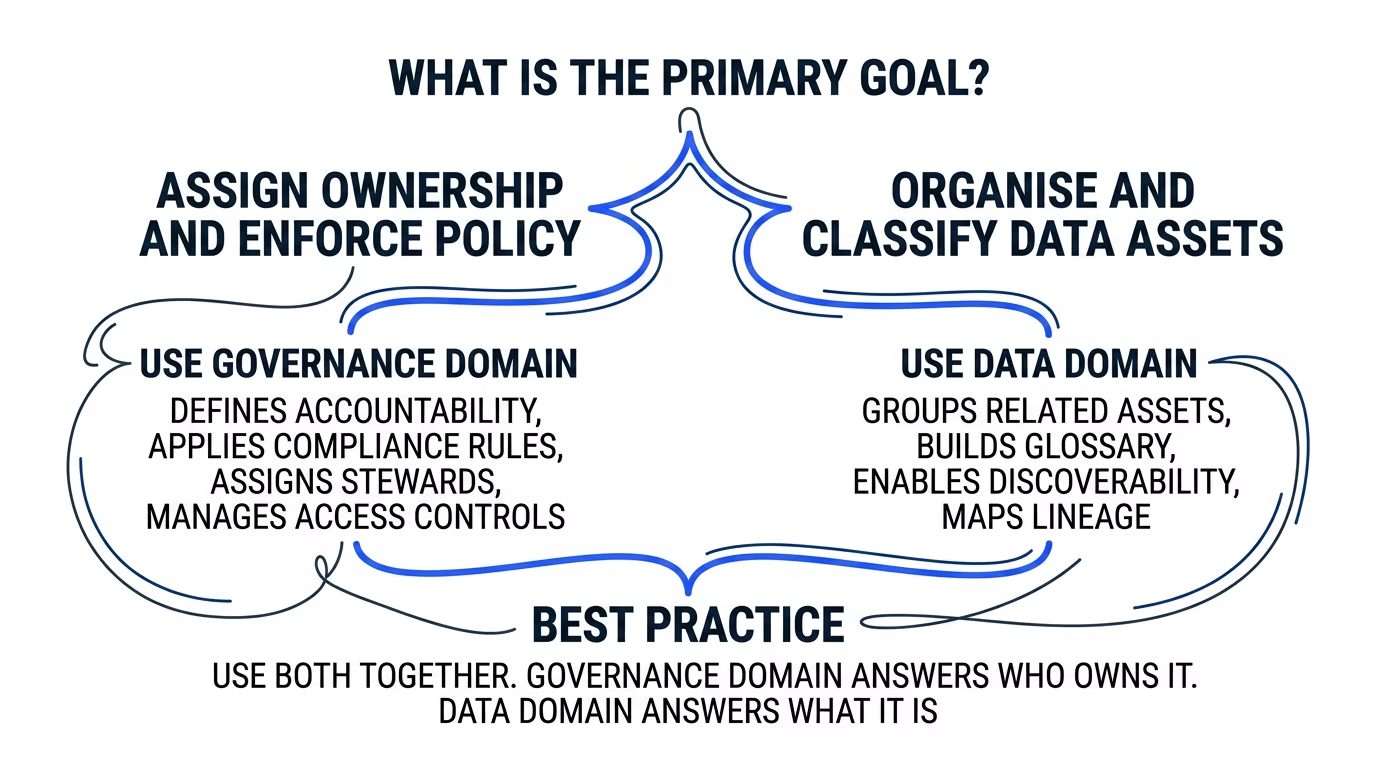
Governance Domain = WHO
Apply when the outcome is accountability, policy, stewardship role assignment, or compliance enforcement. This is your organisational and regulatory layer — it defines governance jurisdiction within Purview.
Data Domain = WHAT
Apply when the outcome is discoverability, semantic organisation, glossary alignment, or lineage mapping. This is your semantic and contextual layer — it makes data findable and meaningful across the catalog.
Best Practice: In a mature Purview implementation, every Governance Domain should have corresponding Data Domains — and vice versa. The two constructs are designed to be used together, not in isolation. Start with Governance Domains to establish ownership, then build Data Domains to scale discoverability and semantic richness.
Key Takeaways
Microsoft Purview's Unified Catalog is most powerful when both domain constructs are deployed together — each fulfilling a distinct and complementary role in your enterprise data governance programme.
Governance Domains = Accountability
They establish who owns data, enforces policy, and holds stewardship responsibility. Essential for regulatory compliance and organisational accountability.
Data Domains = Organisation
They define what data is — grouping assets, glossary terms, and lineage by subject area to power discoverability and semantic clarity across the catalog.
Complementary, Not Competing
These are not two ways to solve the same problem — they solve different problems. A complete Purview implementation requires both, working in tandem across every major subject area.
Together = Complete Governance
Governance Domain + Data Domain = the full governance fabric. One provides the jurisdictional layer; the other provides the semantic layer. Together they form a robust, scalable foundation for enterprise data management.
Recommended Implementation Sequence
Begin with Governance Domains to establish ownership, assign stewards, and apply initial compliance policies to your highest-risk subject areas (Finance, HR, Legal). Once the accountability layer is in place, build out Data Domains to organise assets, populate the business glossary, and enable self-service discovery at scale. This sequencing ensures that governance foundation precedes catalog scale — avoiding the common mistake of cataloguing data without accountability.